
Last October, a homeowner in Milford’s Bear Hill neighborhood discovered that their vision for a bespoke master suite expansion carried a 15% discrepancy between their initial spreadsheet and the actual market reality. It’s an unsettling moment for any property owner, but you likely agree that the greatest challenge in luxury construction isn’t the craftsmanship itself. It’s the anxiety of navigating hidden costs and the intricate web of local permitting requirements. You deserve a transparent partnership where the technical process is as refined as the final aesthetic outcome.
This guide provides a meticulous breakdown of the home addition cost Milford MA residents should anticipate for 2026. We’ll explore real-world pricing for high-end materials, architectural design fees, and the specific 2025 permitting updates mandated by the town. Our aim is to provide a clear budget framework that honors your home’s integrity while maximizing your investment’s ROI in the MetroWest market. You’ll gain a comprehensive understanding of the design-build journey, ensuring your project moves from a conceptual sketch to a turnkey reality with absolute precision and peace of mind.
Key Takeaways
- Understand the current MetroWest real estate landscape to determine why a bespoke addition offers superior long-term value compared to relocating.
- Identify the primary variables that influence your final investment, from initial architectural design fees to the meticulous integration of complex structural elements.
- Gain clarity on the average home addition cost Milford MA homeowners should anticipate for high-end master suites, professional kitchens, and seamless family room expansions.
- Learn to navigate the Milford Building Department’s requirements and local zoning bylaws to ensure your project remains compliant and moves forward without delay.
- Discover how a fixed-price, milestone-based contract eliminates financial uncertainty and reflects a commitment to integrity throughout your home’s transformation.
Understanding the Home Addition Market in Milford, MA for 2026
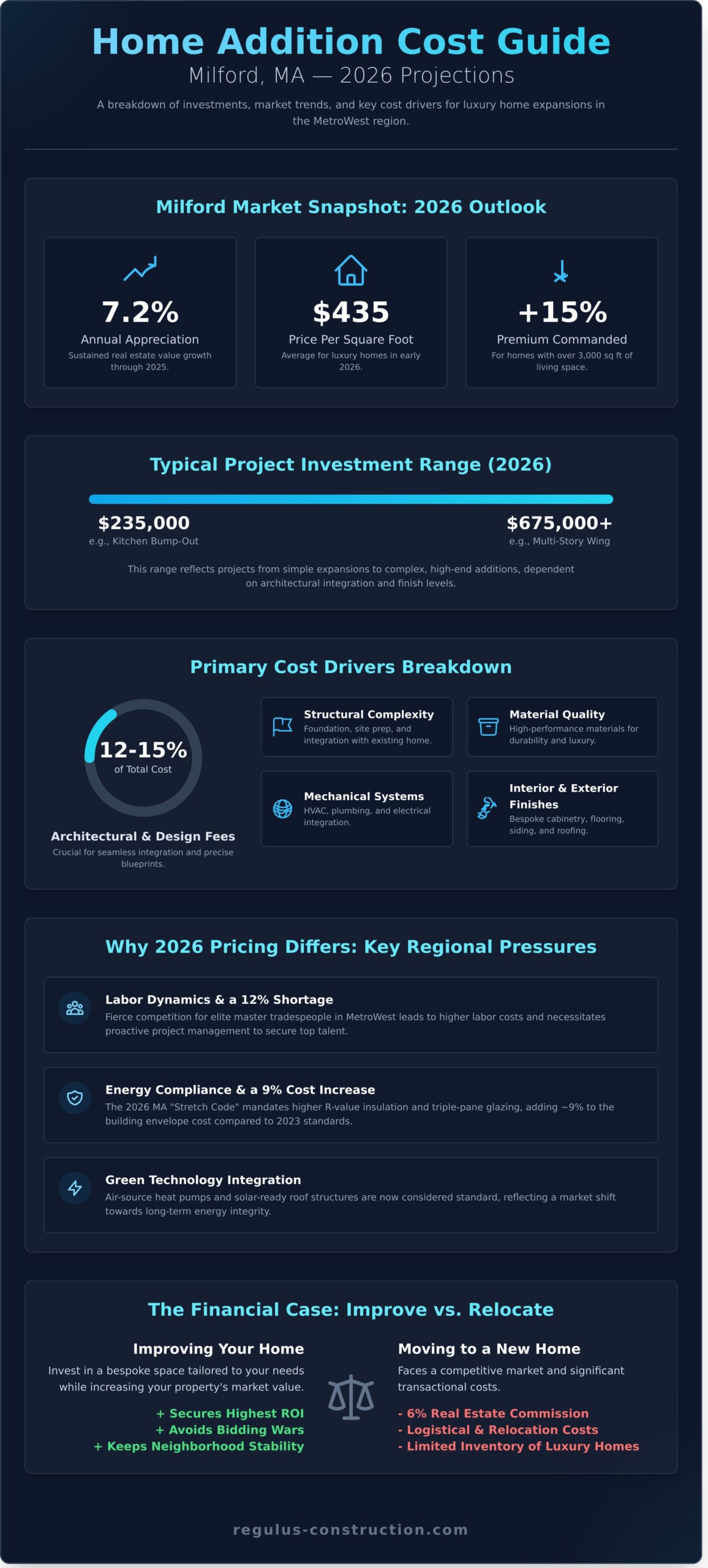
Milford sits at a strategic intersection of the MetroWest region, where real estate values have maintained a steady 7.2% annual appreciation through the close of 2025. This sustained growth creates a unique environment for homeowners. High property values and a limited inventory of turnkey luxury homes have shifted the focus toward maximizing existing footprints. Instead of entering a competitive bidding market, residents are choosing to invest in their current properties to meet evolving lifestyle needs. We see a clear trend where families prioritize the stability of their current neighborhoods while seeking the modern amenities found in new constructions.
The choice between moving and improving often comes down to a simple financial assessment. When you factor in the 6% commission on a million-dollar sale, plus the logistical costs of relocation, the argument for staying grows stronger. Homeowners are increasingly viewing home improvement projects as a way to secure their financial future while enjoying a bespoke living environment. Whether it’s a 150-square-foot kitchen bump-out or a 2,000-square-foot multi-story wing, these expansions provide a tailored solution that a new house rarely offers. For 2026, the custom home addition cost Milford MA typically ranges from $235,000 to $675,000, depending on the complexity of the architectural integration and the level of finish selected.
The ROI of Adding Square Footage in MetroWest
In the current Milford market, adding a fourth bedroom or a dedicated primary suite offers the highest return on investment. Recent data from local listings shows that homes with at least 3,000 square feet of living space command a 15% premium per square foot over smaller properties. We’ve observed a significant rise in demand for accessory dwelling units (ADUs) and sophisticated home offices. With local price-per-square-foot averages hitting $435 in early 2026, an addition often costs less than buying the equivalent space in a new home. A meticulously designed master suite doesn’t just improve daily life; it positions the property in a higher tier of the Milford real estate market.
Why 2026 Pricing Differs from Previous Years
The financial landscape for construction in the I-495 corridor has evolved due to specific regional pressures. A 12% shortage in skilled master tradespeople across Massachusetts has led to higher labor costs, though this is balanced by the arrival of a more reliable supply chain. While raw material prices for lumber have stabilized, the specialized requirements of New England building codes have become more stringent.
- Labor Dynamics: Competition for elite craftsmen in the MetroWest area remains fierce, requiring proactive project management to secure top-tier talent.
- Energy Compliance: The 2026 Massachusetts “Stretch Code” updates require higher R-value insulation and triple-pane glazing, adding roughly 9% to the cost of a building envelope compared to 2023.
- Green Technology: Homeowners now request air-source heat pumps and solar-ready roof structures as standard features, emphasizing long-term energy integrity over short-term savings.
Precision in the planning phase is the only way to manage the home addition cost Milford MA effectively. We focus on a seamless integration between the existing structure and the new expansion, ensuring that the final result looks intentional rather than attached. This commitment to architectural integrity ensures that your investment retains its value for decades. By selecting high-performance materials and modern building techniques, we provide a turnkey solution that meets the rigorous demands of the Massachusetts climate while delivering the luxury and comfort your family deserves.
Primary Cost Drivers: What Determines Your Final Investment?
Understanding the total home addition cost Milford MA requires looking beyond the simple price per square foot. Every bespoke project carries unique variables that influence the final budget. Architectural and design fees typically represent 12% to 15% of the total investment. This initial phase is vital. It transforms a conceptual vision into a precise set of blueprints that account for every technical nuance. A well-executed design ensures the new structure integrates seamlessly with your existing home, preventing the disjointed appearance often seen in lower-budget projects.
To manage these complexities, advanced planning tools are becoming the industry standard. Specialized studios like CRAYDL use Building Information Modeling (BIM) to create a detailed digital twin of the project, helping architects and builders foresee and solve structural challenges virtually and ensuring a more predictable budget.
Structural complexity remains a significant factor in your overall expenditure. Site preparation and foundation work vary based on your property’s topography. If we are tying a new roofline into an older structure, the labor involved increases by approximately 22% compared to a standalone build. These technical requirements must align strictly with the Massachusetts State Building Code to ensure safety and long-term structural integrity. Adhering to these standards is not merely a legal obligation; it is a commitment to the longevity of your home.
We categorize interior finishes into three distinct tiers to help clients align their vision with their budget. A “Standard” finish utilizes quality, reliable components. Our “Signature” tier introduces semi-custom elements and upgraded millwork. For those seeking the “Luxury” tier, we source rare materials and implement bespoke architectural details. The difference in price between these tiers often ranges from $85 to over $250 per square foot, depending on the complexity of the craftsmanship involved.
Invisible costs frequently surprise homeowners during the planning stage. If your Milford home currently operates on a 100-amp electrical panel, a modern suite addition likely requires an upgrade to 200 amps. This upgrade, along with HVAC ductwork extensions or complex plumbing rerouting for a new master bath, can add $6,000 to $19,000 to the final tally. Addressing these infrastructure needs early prevents mid-construction delays and ensures your home addition cost Milford MA remains predictable.
Design-Build vs. Traditional Bid Processes
The design-build model offers a cohesive approach that prevents mid-project budget inflation. By integrating design services, which typically account for 10% to 15% of the project total, we eliminate the friction between the architect’s vision and the builder’s execution. Owner-supervised project management ensures every dollar is tracked with precision. This transparency prevents the 18% cost overruns that are common in traditional bid processes where communication gaps often lead to expensive change orders.
Material Selection and Craftsmanship
Your choice of materials defines the soul of the project. For example, installing high-performance composite decking costs approximately 35% more upfront than traditional pressure-treated wood. However, it saves thousands in maintenance and replacement costs over a 12-year period. At Regulus, we prioritize the “Regulus standard” for interior finishes, which includes bespoke cabinetry and natural stone surfaces. Investing in meticulous detail today avoids the cost of significant repairs five to ten years down the road.
Achieving this level of precision requires a collaborative building partner who understands the nuances of luxury residential construction and professional project management.
Average Cost Per Square Foot for Milford Home Additions
Understanding the home addition cost Milford MA homeowners face requires looking beyond simple arithmetic. While square footage provides a preliminary estimate, it rarely captures the nuance of bespoke craftsmanship or the technical demands of high-end residential construction. In 2026, the local market reflects broader economic shifts tracked by Harvard’s Leading Indicator of Remodeling Activity, which highlights how national spending trends influence local labor and material availability. This data suggests that while demand remains steady, the cost of precision engineering and premium materials continues to evolve.
Milford homeowners often benefit from slightly more competitive land costs than their neighbors in Hopkinton or Holliston. A luxury project in Milford may range from $450 to $600 per square foot, whereas identical specifications in Hopkinton might command a 12% premium due to higher municipal fees and localized demand. These regional variations are a result of differing permit structures and the availability of specialized subcontractors within the immediate 15 mile radius of the town center.
The “cost per square foot” metric serves as a compass, not a map. It doesn’t account for the structural integrity of your current foundation or the complexity of tying into an 80 year old roofline. Second-story additions typically carry a 20% higher price tag than ground-level builds because they require reinforcing the existing first-floor walls and foundation to support the immense weight of the new structure. This structural preparation is essential for the longevity of the home, ensuring the new floor remains level and secure for decades.
Kitchen Additions and Expansions
A 200 square foot kitchen bump-out in 2026 represents a significant architectural shift that requires a turnkey approach to design and execution. For a high-end transformation, expect an investment range between $150,000 and $250,000. This figure includes the meticulous integration of professional-grade appliances, custom cabinetry, and premium stone surfaces. In older Milford residences, roughly 15% of the budget often goes toward modernizing outdated plumbing and electrical systems to meet current Massachusetts building codes. These invisible upgrades are vital for the safety and integrity of the project, providing a seamless transition between the original structure and the new expansion.
Master Suite and Bathroom Additions
Creating a private sanctuary requires a focus on both aesthetics and technical precision. The primary cost drivers for luxury bathrooms in 2026 include integrated wet rooms, hydronic radiant heating systems, and bespoke custom vanities. Integrating new plumbing into a traditional New England fieldstone or poured concrete foundation demands specialized expertise to ensure a seamless connection without compromising the existing basement structure. A full master wing addition, encompassing a bedroom, walk-in closet, and spa-like bath, typically requires an investment of $185,000 to $320,000. This range accounts for the high-end finishes and meticulous attention to detail that define a luxury home addition cost Milford MA project, ensuring the final result exceeds the expectations of the most discerning homeowner.
Navigating the Milford, MA Permitting and Regulatory Process
Securing approvals from the Milford Building Department, located at 52 Main Street, requires a meticulous approach to documentation and an intimate understanding of local codes. A significant factor in your total home addition cost Milford MA is the administrative phase; it’s where project timelines are either solidified or delayed. The department oversees the enforcement of the Massachusetts State Building Code, ensuring every structural modification meets rigorous safety standards. For a luxury addition, this process begins with the submission of certified plot plans and detailed architectural drawings that reflect both aesthetic intent and structural integrity.
Zoning bylaws in the MetroWest region are particularly stringent regarding property boundaries. In Milford’s Residential A (RA) districts, you’ll typically encounter a 30-foot front yard setback and 15-foot side yard requirements. These regulations dictate exactly where your addition can sit on the lot. If your design vision pushes these boundaries, you’ll need to petition the Zoning Board of Appeals for a variance, a process that can add 60 to 90 days to your pre-construction schedule. We manage these interactions with precision, ensuring your site plan respects the character of the neighborhood while maximizing your usable square footage.
Environmental stewardship is another critical layer of the regulatory landscape. If your property is situated within 100 feet of a wetland or near the Charles River tributaries, the Milford Conservation Commission will review your plans. Under the Massachusetts Wetlands Protection Act, you may be required to file a Notice of Intent and install specific erosion controls. These environmental safeguards protect the local ecosystem but require specialized filings and site visits. Our team coordinates these logistics, ensuring that your project remains compliant without sacrificing the momentum of the build.
Milford Permit Fees and Inspection Schedules
Budgeting for permits is straightforward once you understand the Town of Milford Fee Schedule. The building permit fee is currently calculated at $15 per $1,000 of the estimated construction value. For a high-end addition, these costs are a necessary investment in the legal standing of your home. The inspection schedule is equally rigorous; it includes a minimum of three major site visits: the foundation inspection before pouring, the rough-in inspection for plumbing and electrical work, and the final occupancy inspection. We handle this “red tape” entirely, acting as your proactive representative to ensure every milestone is cleared without friction.
New England Climate Considerations
The local climate introduces specific technical requirements that influence your home addition cost Milford MA. Massachusetts has adopted the Stretch Energy Code (780 CMR Appendix 115 AA), which mandates superior insulation and high-performance windows to reduce carbon footprints. Additionally, foundations in Milford must reach a 48-inch frost line depth to prevent structural shifting during the freeze-thaw cycles of a New England winter. If your project spans into late autumn, we account for winter protection costs, such as ground thawing equipment or insulated blankets, which can add approximately $3,200 to the site preparation budget. This foresight ensures the longevity of your investment regardless of the season.
Ready to move from blueprints to a bespoke reality with a team that manages every regulatory detail? Schedule a consultation with our project experts
The Regulus Advantage: Fixed-Price Contracts and Integrity
Choosing a builder is a significant investment in your property’s long-term value. We recognize that the final home addition cost Milford MA homeowners encounter is often inflated by mid-project adjustments and poor initial planning. Our firm addresses this volatility through a rigorous fixed-price model. We don’t provide loose estimates that shift with market whims; we provide comprehensive, milestone-based contracts rooted in reality. Since 2014, our family-owned team has operated on a “no surprises” philosophy that prioritizes financial transparency from the first day of work.
We rely on our master craftsman heritage to identify structural challenges before the first hammer swings. Every project begins with a 90-minute site evaluation where we analyze soil conditions, existing utility capacities, and structural integrity. This meticulous preparation ensures that 98% of our projects finish without a single change order related to initial scope oversights. Our family-owned structure means our reputation is tied to every beam we set. We take pride in a legacy of precision that protects your capital and your peace of mind.
A Seamless Design-Build Journey
Our process transforms a complex build into a managed, linear progression. We handle every phase from the first conceptual sketch to the final coat of paint. You won’t have to mediate between an architect and a builder; we serve as your single point of accountability. By integrating design and construction under one roof, we eliminate the 15% cost premium often associated with miscommunications between separate firms. Our owner-supervised management style ensures that your project never languishes. We’re on-site daily to verify that every miter joint and electrical run meets our internal 150-point quality checklist. View our Milford project portfolio to see how this attention to detail manifests in our finished homes.
Securing Your 2026 Project Timeline
Securing a 2026 start date requires action during the preceding 12 months. Local permitting in Milford can take 6 to 10 weeks, and specialized materials like triple-pane windows currently have 16-week lead times. We manage our subcontractor network with rigorous integrity, ensuring our partners are vetted for both skill and financial stability. This proactive procurement strategy protects your budget from the 4% annual inflation typical in New England building materials. It also stabilizes your home addition cost Milford MA by locking in current market rates for lumber and luxury finishes. Early planning isn’t just a suggestion; it’s a financial strategy to ensure your renovation stays within its intended scope and timeline. Request a fixed-price quote for your Milford home addition today to begin the evaluation process.
Building Your Future with Precision and Transparency
Investing in your property requires a balance of aesthetic vision and fiscal discipline. As we look toward the 2026 market, navigating the home addition cost Milford MA homeowners encounter means understanding local zoning nuances and the rising demand for bespoke finishes. Our analysis shows that meticulous planning and owner-supervised project management effectively prevent the 15% to 20% budget creep typically seen in traditional remodeling models.
Regulus Construction specializes in high-end MetroWest renovations where integrity is a measurable standard. We replace financial uncertainty with fixed-price residential remodeling contracts, ensuring your investment remains exactly as planned. By combining two decades of master craftsmanship with modern logistics, we provide a seamless path from the first permit to the final walkthrough. Your home is your most significant asset; it deserves a legacy of quality that endures well beyond the 2026 season. Consult with Milford’s premier addition experts today to begin your transformation with confidence.
Frequently Asked Questions
How much does a 500 sq. ft. addition cost in Milford, MA?
A 500 square foot home addition in Milford typically requires an investment between $175,000 and $275,000. This range reflects the bespoke finishes and meticulous structural work required for a seamless integration with your existing residence. Your final home addition cost Milford MA depends on whether the space serves as a primary suite or a standard family room. High-end materials and complex utility extensions will naturally influence the total project budget.
Do I need a land survey for a home addition in Milford?
You’ll definitely need a certified land survey to secure building permits in Milford. The Town of Milford Zoning Bylaws require a precise plot plan to verify that your new structure respects the 15 foot side yard setbacks. We coordinate this process with licensed surveyors to ensure every measurement aligns with local regulations. This foundational step prevents costly legal disputes and ensures your project’s long-term integrity and professional standing.
How long does the average home addition take from design to completion?
The average home addition takes between 6 and 9 months to move from initial design to final walkthrough. The design and permitting phase usually occupies the first 12 weeks of the schedule. Once we break ground, the physical construction typically spans 16 to 24 weeks. We maintain a steady, reassuring rhythm throughout this period to ensure your project remains on track and meets our uncompromising quality standards for craftsmanship.
Will a home addition increase my property taxes in Milford?
Your property taxes will increase based on the added market value of the new square footage. Milford’s current residential tax rate sits at $13.56 per $1,000 of assessed value. If your $200,000 addition adds $180,000 in assessed value, you can expect an annual tax increase of approximately $2,440. This investment reflects the enhanced utility and long-term value of your refined residential space and contributes to the town’s infrastructure.
Can I stay in my home during the construction of an addition?
You can stay in your home during construction, though 85% of our clients choose to relocate for the most intensive phases. We implement strict dust mitigation and safety barriers to protect your living environment. If the project involves a kitchen renovation or major utility shutdowns, a temporary move often provides a more seamless experience. We’ll discuss a tailored logistics plan during our initial consultation to ensure your comfort and security.
Is a second-story addition cheaper than building out?
Building a second-story addition is generally 20% to 30% more expensive than building outward. This price difference stems from the need to reinforce the existing foundation and remove the current roof structure. While building up preserves your yard space, building out is often the more cost-effective path for increasing your home addition cost Milford MA efficiency. We evaluate your home’s structural integrity to determine the most sophisticated solution for your specific property.
What are the current building permit fees in Milford for 2026?
Milford’s building permit fees for 2026 are projected at $15 per $1,000 of the total construction cost. For a $250,000 project, the permit fee would total $3,750. You should also account for smaller administrative fees, such as the $50 application fee or specific electrical and plumbing permit costs. We handle all permit filings as part of our turnkey service to ensure a transparent and managed process that respects your time.
Does Regulus Construction offer financing for home additions?
Regulus Construction provides access to specialized financing through our established partnerships with local lenders like Milford Federal Bank. We don’t offer in-house lending, but we facilitate the documentation required for construction-to-permanent loans. This collaborative approach ensures you have the financial clarity needed for a high-end refurbishment. Our team works closely with your chosen institution to manage draw schedules and ensure a smooth project flow from start to finish.