
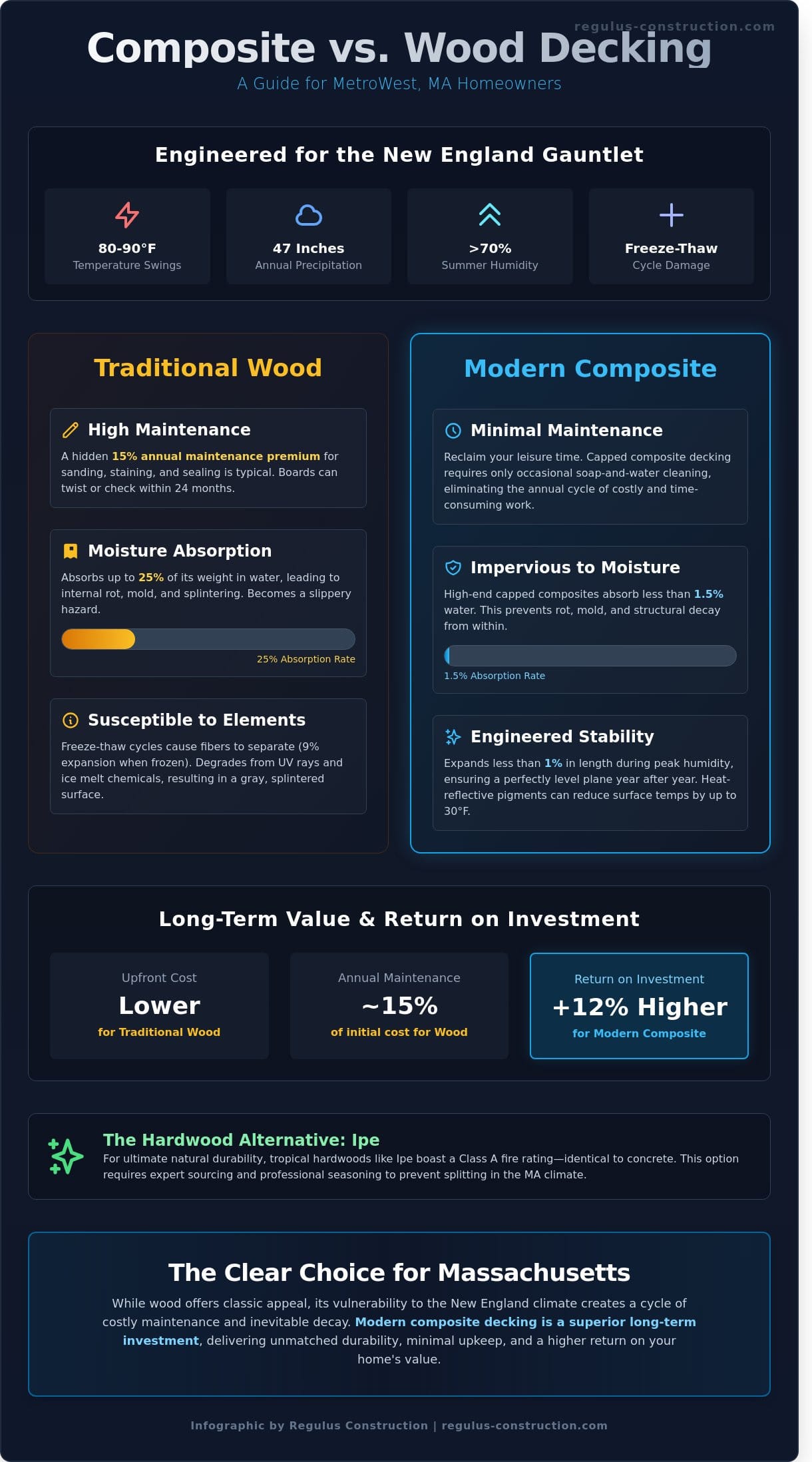
The lower upfront cost of a traditional cedar deck often masks a hidden 15 percent annual maintenance premium that compounds with every humid New England summer. You likely chose your home in the I-495 corridor for its architectural integrity and the promise of serene weekend afternoons spent outdoors. It’s frustrating when that vision is interrupted by the reality of splintering boards and the relentless cycle of sanding required to combat 90 degree humidity and sub-zero winters.
Our 2026 comparison of composite vs wood decking MA ensures you can reclaim your leisure time while making a meticulous investment in your property. You’ll discover which materials truly survive the local climate and how a bespoke installation can provide a 12 percent higher return on investment compared to standard wood alternatives. We’ll examine the technical durability of modern synthetics alongside the classic appeal of timber to help you achieve a seamless, high-end finish that honors your home’s unique character.
Key Takeaways
- Understand how the rigorous New England freeze-thaw cycle impacts material longevity and learn to select a surface that maintains its structural integrity through every season.
- Discover how modern material science allows for a seamless aesthetic, offering the sophisticated grain patterns of premium hardwoods with significantly enhanced durability.
- Evaluate the true cost of the annual maintenance cycle to reclaim your leisure time without compromising the visual appeal of your outdoor living space.
- Analyze the long-term financial implications of composite vs wood decking MA to ensure your investment maximizes both your home’s market value and your personal enjoyment.
- Learn how a bespoke, owner-supervised construction approach integrates your new deck into the existing architectural narrative of your MetroWest home.
The New England Climate Challenge: Why Deck Material Choice Matters in Milford and Beyond
Homeowners in MetroWest face a distinct architectural challenge. They must balance the timeless aesthetic of a luxury outdoor space with the brutal reality of Massachusetts weather. This “New England Deck Dilemma” forces a choice between the organic warmth of timber and the engineered resilience of modern materials. When evaluating composite vs wood decking MA, the decision often hinges on how a structure survives the 80-degree temperature swings common between January and July.
The 47 inches of annual precipitation in the region creates a relentless cycle of saturation. This moisture penetrates wood pores, leading to internal decay that often remains hidden until structural integrity is compromised. Our meticulous approach at Regulus Construction ensures that every material choice accounts for these environmental stressors to provide a seamless transition from your interior living space to the outdoors. We prioritize longevity and precision, recognizing that a deck is a significant investment in your home’s value.
Weathering the Storm in Medway and Medfield
Pressure-treated lumber in Norfolk County often begins to twist or “check” within the first 24 months of installation. Snow accumulation, which averaged 50 inches in some MetroWest towns during recent winters, creates a constant moisture load. Ice melt chemicals further degrade wood fibers; this leads to a grey, splintered finish that requires annual sanding. Freeze-thaw stress is the mechanical pressure exerted when absorbed moisture within deck joists expands by 9% upon freezing, forcing wood fibers to separate and lose structural integrity.
The Humidity Factor in the MetroWest Region
Towns like Holliston and those near the Charles River basin experience summer humidity levels that frequently exceed 70%. This moisture promotes rapid organic growth; it turns a once-pristine surface into a dark, slippery hazard. While some contractors claim wood “breathability” is an advantage, it’s often a misunderstood concept that allows internal rot to fester while the surface appears dry. We’ve found that high-end projects require materials that resist this biological pressure without compromising on style.
- Surface Moisture: Evaporates quickly but leaves behind minerals and spores that feed mold.
- Internal Rot: Occurs when core moisture levels stay above 20% for extended periods, invisible to the naked eye.
- Absorption Rates: Modern composite vs wood decking MA comparisons show that while wood absorbs up to 25% of its weight in water, high-end capped composites remain below 1.5%.
Choosing the right material isn’t just about the first summer. It’s about how the deck looks after five winters in Medfield. We guide our clients through this selection process with an unwavering eye for detail, ensuring the final product reflects the integrity of their home.
Material Science: Comparing Performance and Aesthetics for Hopkinton and Sudbury Homes
The decision between composite vs wood decking MA homeowners encounter often hinges on the intersection of biological reality and engineering precision. In the MetroWest region, materials must endure temperature fluctuations that can span 90 degrees Fahrenheit between a February freeze and a July heatwave. This thermal cycling forces organic wood fibers to expand and contract, a process that eventually compromises the structural integrity of lesser materials. High-end composites solve this through a meticulous blend of recycled polymers and reclaimed wood fibers, creating a board that expands less than 1% of its length during peak summer humidity.
Stability remains the primary differentiator. While a standard pressure-treated board might cup or twist within 24 months of installation, modern composites maintain a perfectly level plane. This precision allows our team to execute complex, flush-mounted designs that mirror the sophisticated interior flooring of a Sudbury estate. The tactile experience has also evolved; high-performance boards now incorporate heat-reflective pigments that reduce surface temperatures by up to 30 degrees compared to traditional early-generation composites. This ensures a barefoot-friendly environment for families during the height of the New England summer.
The Hardwood Alternative: Ipe and Mahogany
For luxury residences in Southborough and Wellesley, tropical hardwoods like Ipe represent the pinnacle of natural durability. Ipe possesses a density so high it carries a Class A fire rating, identical to concrete or steel. Sourcing these exotic woods in the current 2026 market requires a partnership with suppliers who prioritize sustainable forestry and meticulous drying processes. Without professional seasoning, these woods can check or split when exposed to the harsh winds of the I-495 corridor.
- Maintenance: To preserve the deep, chocolate tones of Ipe, homeowners must apply a UV-inhibiting hardwood oil annually.
- Longevity: Left untreated, these woods weather to a sophisticated silver patina that lasts 40 years or more.
- Installation: The sheer density of Ipe requires pre-drilling every fastener, a labor-intensive process that demands a master craftsman’s touch.
Composite Innovation: Beyond the “Plastic” Look
Modern engineering has successfully addressed the “visual integrity” objection that once plagued synthetic materials. Leading brands Regulus trusts, such as Trex and TimberTech, utilize multi-tonal capping technology. This process involves co-extruding multiple shades of pigment to create the variegated grain patterns found in natural timber. The result is a bespoke appearance that captures the soul of wood without the inherent risk of splintering or rot. These non-organic surfaces are impervious to the moisture-driven mold common in shaded Hopkinton backyards, ensuring the deck remains a seamless extension of the home’s living space. If you are envisioning a space that balances this aesthetic beauty with long-term resilience, our team can guide you through a bespoke deck design tailored to your property’s specific topography.
Maintenance Realities: Living with Your Deck in Norfolk and Mansfield
A bespoke outdoor space should serve as a private retreat, not a recurring entry on your seasonal to-do list. When evaluating composite vs wood decking MA, the most significant differentiator is the commitment required to preserve the structure’s integrity. In the MetroWest area, our climate presents a unique challenge; the transition from humid July afternoons to the deep freezes of January accelerates the degradation of organic materials. Choosing a material that aligns with your lifestyle is as vital as the architectural design itself.
The Hidden Labor of Wood Decks
Maintaining a natural timber deck in towns like Mansfield requires a level of dedication that many homeowners underestimate. Over a 10-year period, a traditional wood deck demands approximately 320 hours of active labor to prevent rot and splintering. This cycle begins every May with a meticulous power wash, followed by a mandatory 48-hour drying period before any sanding can commence. The humidity levels in Norfolk often complicate this process, as trapped moisture can cause new stains to peel within six months.
The environmental impact of this upkeep is also a growing concern for residents near the Charles River watershed. Annual applications of oil-based sealants often release high levels of Volatile Organic Compounds (VOCs) into the surrounding ecosystem. By the third winter, the relentless freeze-thaw cycle typically causes 15% of pressure-treated boards to warp or check. This physical decline often leads to a sense of “maintenance fatigue” among homeowners who initially sought the charm of natural wood.
The “Set and Forget” Appeal of Composite
Modern composite materials offer a sophisticated solution for those who value both aesthetics and time. These boards are engineered with an inorganic protective shell that remains impervious to the wood-boring insects, such as carpenter bees and termites, that are prevalent in New England. For a Milford home, the maintenance routine is reduced to a simple rinse with a garden hose and mild soap twice a year. This efficiency ensures your deck is always ready for guests without the need for a weekend of prep work.
- Stain Resistance: High-performance polymers prevent grill grease and wine spills from penetrating the surface, allowing for a seamless cleanup.
- Color Longevity: While natural wood begins to oxidize into a dull gray within 18 months, composite retains its rich hue for decades.
- Guaranteed Performance: Most premium 2026 composite lines include a 25-year fade and stain warranty, providing a level of security that timber cannot match.
The transition to composite reflects a broader shift toward turnkey luxury in the composite vs wood decking MA market. It’s a choice that prioritizes long-term peace of mind, ensuring that your investment remains as striking in year ten as it was on the day of completion.
Investment and ROI: Calculating the Long-Term Value in the I-495 Corridor
Selecting the right material for an outdoor living space involves more than aesthetic preference; it requires a clear-eyed analysis of long-term asset management. When evaluating composite vs wood decking MA residents must weigh the immediate gratification of lower costs against the enduring value of a maintenance-free lifestyle. In the affluent pockets of the I-495 corridor, a deck serves as a vital component of a home’s architectural integrity and market positioning. While wood offers a classic appeal, the significant initial investment in composite materials often yields a more predictable financial outcome for the sophisticated homeowner.
The Math Behind the Deck
In the 2026 MetroWest market, professional labor for complex, custom designs remains a primary driver of project costs. While a traditional pressure-treated deck might require an investment of $30 to $45 per square foot, a bespoke composite system typically averages between $70 and $95 per square foot. However, the true cost of ownership reveals itself over a 15-year horizon. Wood requires professional sanding and staining every 24 to 36 months, an expense that can easily exceed $18,000 over the deck’s lifespan for a standard 500-square-foot space. Data from regional appraisals suggests that composite decks typically recoup 60-70% of their cost at resale, as buyers increasingly prioritize materials that don’t demand annual labor.
Why Quality Matters in the MetroWest Market
A deteriorating deck is a liability that savvy buyers in Natick and Bellingham won’t ignore. During a home inspection, rot or structural instability in an aging wood deck can lead to significant price concessions or delayed closings. In contrast, the seamless finish of a high-end composite installation enhances curb appeal and suggests a meticulously managed estate. For homeowners in Hopedale, providing a turnkey outdoor environment is a powerful differentiator in the premium real estate market. This commitment to longevity and craftsmanship ensures your property remains a sought-after asset for years to come. To begin your journey toward a superior outdoor space, request a meticulous project estimate for your new deck from our expert team. We focus on delivering a finished product that stands as a testament to both luxury and durability.
The Regulus Construction Approach: Bespoke Deck Solutions in Franklin and Mendon
Regulus Construction views outdoor living through a lens of architectural continuity. We don’t see a deck as an isolated platform; it’s a vital chapter in your home’s narrative. Whether we’re working in Franklin or Mendon, our philosophy centers on creating a transition that feels intentional and permanent. Every project benefits from owner-supervised management, ensuring the original vision isn’t lost between the design phase and the final board placement.
Our background in professional painting gives us a distinct advantage in the MetroWest market. This history informs a meticulous eye for finish and detail that many builders overlook. We understand how light interacts with different textures, which is a critical factor when deciding between composite vs wood decking MA. Our commitment to transparency is solidified through fixed-price contracts and seamless project execution. This approach eliminates the common 15% to 20% budget creep seen in less organized builds, providing you with absolute financial clarity from day one.
Design-Build Excellence
We collaborate closely with you to determine if a natural cedar or a high-performance composite suits your daily habits. If you host large gatherings, we might suggest multi-level transitions to define different social zones. We specialize in bespoke features like integrated LED lighting and custom perimeter seating that transforms a simple deck into a turnkey outdoor lounge. By aligning the floor heights and material palettes, we ensure your new deck feels like an organic extension of your kitchen or living room.
Craftsmanship in Every Joint
Structural integrity is the foundation of our reputation. We utilize advanced hidden fastener systems to create a clean, fastener-free surface that highlights the material’s beauty. Our precision-driven approach prevents the ledger board failures and joist decay that account for nearly 90% of deck collapses in older structures. We don’t cut corners on flashing or hardware because we build for longevity. You can view our portfolio of MetroWest deck transformations to see how our technical expertise meets high-end design.
Securing the Future of Your MetroWest Landscape
Choosing between composite vs wood decking MA involves more than a simple aesthetic preference; it’s a strategic investment in your home’s longevity. While premium cedar offers a classic 15 year lifespan when meticulously maintained, modern composite boards provide a 25 year performance guarantee against the harsh New England freeze-thaw cycles. Data from 2024 regional real estate reports indicate that bespoke outdoor spaces in towns like Franklin and Sudbury recover approximately 68% of their cost during resale. Our approach ensures this value is protected through owner-supervised project management and our signature fixed-price residential remodeling contracts. We understand the specific architectural nuances of MetroWest homes, from traditional Colonials to contemporary builds. By prioritizing technical precision and transparent communication, we transform complex construction into a seamless experience. We’re ready to bring your vision to life with the high standards your property deserves. Partner with Regulus Construction for your bespoke deck project and enjoy the peace of mind that comes with master craftsmanship. Your ideal outdoor sanctuary is well within reach.
Frequently Asked Questions
Is composite decking really worth the extra cost in Massachusetts?
Composite decking provides a superior return on investment for MetroWest homeowners when calculated over a 25 year lifecycle. While the initial capital requirement is 40% higher than pressure treated lumber, you’ll eliminate the $1,200 biennial staining costs common in our variable climate. By 2030, the cumulative savings on maintenance and materials often exceed the original price gap, making it a fiscally prudent choice for high end properties.
Does composite decking get too hot for bare feet during MA summers?
Modern capped polymer decking utilizes heat-dissipating technology to remain comfortable even during 90 degree July afternoons in Massachusetts. High performance collections from 2025 reflect up to 35% more solar radiation than traditional composite materials used a decade ago. Choosing lighter shades like sea salt gray or sand dunes further reduces surface temperatures by an additional 15 degrees, ensuring a barefoot friendly environment for your family.
How long does a wood deck typically last in the MetroWest climate?
A professionally installed pressure treated wood deck in the MetroWest area typically reaches its structural limit between 12 and 15 years. The harsh New England freeze-thaw cycles cause standard lumber to check and warp without meticulous annual sealing. In contrast, premium hardwoods like Ipe often maintain their integrity for 40 years or more when we apply UV-protectant oils every 18 months to preserve the natural grain.
Can I install a composite deck over my existing wood frame in Milford?
You can resurface an existing frame in Milford if the substructure meets the 12 inch or 16 inch on center spacing requirements for composite materials. Our team performs a 10 point structural integrity audit to ensure the ledger board and posts are free from fungal decay. If the frame is older than 10 years, we typically recommend a full replacement to ensure the new 30 year decking outlasts its foundation.
Which decking material is best for resale value in the I-495 corridor?
Composite decking currently commands a higher resale premium, with the 2025 Cost vs. Value report indicating a 68% return on investment for MetroWest homes. Buyers along the I-495 corridor prioritize turnkey outdoor spaces that don’t require immediate labor. When comparing composite vs wood decking MA options, the maintenance-free appeal of high-end synthetics often accelerates the sale of luxury residential properties by 14 days on average.
Does composite decking fade over time in the New England sun?
Modern composite materials are engineered to retain 95% of their original luster over a 30 year period. Manufacturers now provide comprehensive warranties that guarantee the boards won’t fade more than 5 Delta E units, which is a change barely perceptible to the human eye. This level of precision ensures your deck maintains its aesthetic integrity despite the intense UV exposure common during our peak summer months.
What is the best wood species for a deck if I want a natural look in MA?
Ipe remains the gold standard for homeowners seeking a bespoke natural aesthetic, boasting a Janka hardness rating of 3,510 lbf. This dense Brazilian hardwood resists rot and wood-boring insects naturally without the need for chemical treatments. For a softer experience, we utilize Grade A Western Red Cedar, which requires a high-quality UV inhibitor applied every 24 months to prevent the silvering effect caused by New England weather.
How much maintenance does a composite deck actually require?
Maintaining a high-end composite deck requires only two basic cleanings per year to remove seasonal pollen and debris. You’ll spend approximately 4 hours annually using a soft-bristle brush and pH-neutral cleanser to keep the surface pristine. This represents a 90% reduction in labor compared to wood decks. When evaluating composite vs wood decking MA, the elimination of sanding and staining remains the most significant advantage for busy professionals.