
What if the most significant opportunity to increase your home’s value isn’t found in the surrounding landscape, but in the air directly above your existing footprint? For many homeowners in Milford and the MetroWest region, the decision to build upward is a sophisticated solution to a lack of space, yet it often comes with a heavy weight of uncertainty. You understand that a project of this scale requires more than just lumber; it demands an unwavering commitment to structural integrity. Navigating the second story addition cost Massachusetts can feel daunting when faced with the complexities of 2026 material projections and the intricate engineering required to protect your original foundation.
We believe that luxury is found in transparency and the peace of mind that comes from a fixed-price budget. This guide provides a meticulous breakdown of investment levels, from the essential structural upgrades required by local building codes to the bespoke architectural details that ensure a seamless transition. You’ll discover how we manage the rigorous permitting processes of historical districts and the specific cost drivers unique to our local market. This overview offers a clear, expert roadmap for transforming your residence through a process that prioritizes precision, longevity, and professional reliability.
Key Takeaways
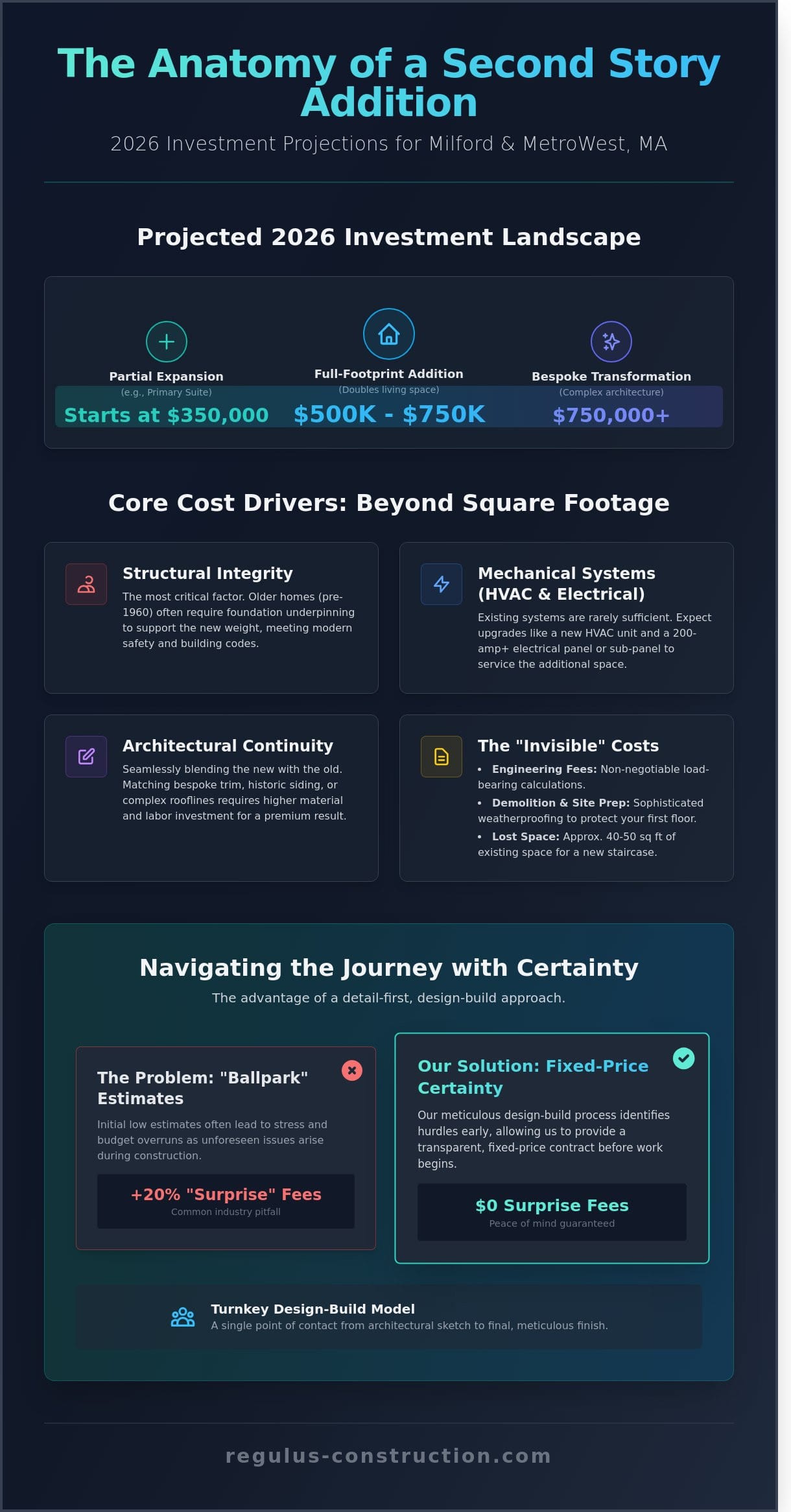
- Establish the 2026 investment landscape in MetroWest, where projects range from $350,000 for partial expansions to over $750,000 for bespoke, full-footprint additions.
- Identify the critical structural and mechanical drivers—such as foundation underpinning and HVAC upgrades—that define the second story addition cost Massachusetts homeowners encounter.
- Learn how a turnkey design-build model provides a seamless journey, offering a single point of contact from the initial architectural sketch to the final meticulous finish.
- Discover how to achieve fixed-price certainty and professional reliability when navigating the technical complexities of expanding your home in towns like Wellesley and Medway.
- Understand the “Regulus Advantage” and how a detail-first approach ensures your vertical expansion is executed with the same precision as a high-end refurbishment.
Estimating Your Second Story Addition Investment in Milford and MetroWest
In 2026, homeowners in Milford and the MetroWest area are viewing home expansions as long-term investments in both lifestyle and equity. A partial second story addition often starts at $350,000. For those seeking a full-footprint expansion, the investment typically ranges between $500,000 and $750,000. These figures reflect a commitment to meticulous craftsmanship and owner-supervised quality control. While some look at a simple price per square foot, this metric is often misleading for vertical additions. Unlike new construction on a vacant lot, a second story requires complex structural integration and demolition. Gaining a clear understanding the renovation process is essential; the second story addition cost Massachusetts homeowners face includes the reinforcement of the existing foundation and the seamless blending of new and old systems.
Investment Tiers by Project Scope
- Tier 1: The Primary Suite Retreat. This scope involves adding a luxury bedroom and bath over an existing garage or wing. It’s a focused expansion that provides a private sanctuary without altering the entire footprint.
- Tier 2: The Full Level Expansion. This tier doubles the living space. It includes multiple bedrooms, bathrooms, and laundry facilities. It’s a comprehensive solution for growing families who love their current neighborhood.
- Tier 3: The Custom Architectural Transformation. This involves complex rooflines, dormers, and high-end exterior matching. It’s designed for those who require a bespoke aesthetic that transforms the home’s silhouette. Understanding these variables helps clarify the second story addition cost Massachusetts residents should expect for premium results.
Fixed-Price vs. Estimates
A “ballpark estimate” is often a source of stress in the construction industry. Regulus Construction operates differently by providing fixed-price residential remodeling contracts. Our detailed design-build planning during the pre-construction phase identifies potential hurdles early. This proactive approach eliminates the 20% “surprise” fees that often plague less organized projects. We believe in transparency and professional project management. Every dollar is accounted for before the first hammer swings. This level of precision ensures that the complexity of vertical construction feels manageable and well-ordered for every client.
Key Cost Drivers for Adding a Level in Medway, Wellesley, and Beyond
The investment required for a vertical expansion depends on several variables that extend beyond simple square footage. When calculating your second story addition cost Massachusetts residents must account for the structural integrity of the existing home. Foundations in older towns like Hopkinton or Franklin, particularly those built before 1960, often require underpinning to support the weight of a new level. This meticulous reinforcement ensures the structure remains stable for decades and meets modern safety standards.
Mechanical systems also dictate the budget. A standard 200-amp electrical panel might suffice for a single-story ranch, but adding three bedrooms and two baths often necessitates a panel upgrade or a secondary sub-panel. Similarly, your current HVAC system likely lacks the capacity to condition 1,200 additional square feet. According to the Cost vs. Value Report, these infrastructure improvements represent a significant portion of the project’s long-term resale value. In Wellesley or Southborough, architectural continuity is paramount. Matching bespoke trim profiles or historic cedar siding preserves the home’s aesthetic integrity but requires a higher material and labor investment than standard off-the-shelf options.
The Invisible Costs: Engineering and Site Prep
Professional engineering fees are a non-negotiable expense. A structural engineer must perform load-bearing calculations to ensure your home meets modern seismic and wind codes. Demolition involves more than just removing a roof; it requires a sophisticated weatherproofing strategy to protect your first-floor finishes during construction. You’ll also lose approximately 40 to 50 square feet of existing living space to accommodate the new staircase, a factor that requires clever floor plan integration to maintain a seamless flow.
Town-Specific Considerations in MetroWest
Zoning and environmental regulations vary significantly across the I-495 corridor. In towns like Norfolk or Holliston, adding bedrooms may trigger a mandatory Title 5 septic inspection. If your system was installed before 1995, an upgrade could add $30,000 or more to your total project budget. Historical districts in Mendon or Medfield often mandate specific materials, such as wood-clad windows, to maintain the neighborhood’s character. If you’re ready to explore a bespoke design-build solution for your home, understanding these local nuances is the first step toward a successful build. You can find more localized planning tips in our guide to Home Additions in MetroWest MA.
Navigating the Design-Build Journey with Fixed-Price Certainty
Regulus Construction brings a unique perspective to large scale renovations. Our background in high end painting informs a detail-first philosophy that many traditional builders overlook. We view every project through the lens of the finished product, ensuring every structural choice supports a flawless final aesthetic. This turnkey approach provides you with a single point of contact from the first conceptual drawing to the final brushstroke, eliminating the friction often found between architects and contractors.
Our principals manage every project personally. This owner-supervised model ensures the integrity of every beam and joist. In communities like Natick and Sudbury, we respect the rhythm of family life. We maintain a clean, organized job site and stick to a defined schedule, typically completing major additions within a 20 to 24 week window. By managing the second story addition cost Massachusetts homeowners face with fixed-price contracts, we remove the anxiety of budget creep.
The Design-Build Lifecycle
- Phase 1: We begin with a feasibility study. This process aligns your vision with a realistic 2026 budget, ensuring your design is both beautiful and buildable.
- Phase 2: Our team guides you through meticulous material selection. We source everything from custom energy efficient windows to high end fixtures for your luxury bathroom remodeling needs.
- Phase 3: Execution focuses on safety and uncompromising craftsmanship. We implement daily site cleanups and strict dust mitigation to protect your existing living space.
Once the build is complete, a thorough post-construction cleanup is the final step to making the new space truly move-in ready. While this article focuses on residential additions, in the commercial sector, businesses rely on professional teams like RPS Building Services to handle this critical final detail, ensuring every surface is pristine after a major project.
Protecting Your Investment and Peace of Mind
Transparent communication serves as our foundation. A successful high-stakes renovation requires a partner who understands the specific architectural heritage of the MetroWest area. Whether you’re preserving a classic Colonial profile or introducing a modern vertical expansion, we ensure the new structure integrates seamlessly with the original home. Our goal is to provide a bespoke result that enhances both your lifestyle and your property’s long term market value.
Ready to elevate your home? Schedule a consultation with Regulus Construction to discuss your bespoke home addition and receive a professional assessment of your project’s potential.
Elevating Your Vision with Financial Certainty
Investing in your home is a significant decision that requires both creative vision and fiscal discipline. As you evaluate the second story addition cost Massachusetts homeowners can expect in 2026, it’s clear that detailed planning is the foundation of a successful build. We’ve explored how regional drivers in Wellesley and Medway influence your total investment, from structural reinforcement to bespoke finishes. A turnkey approach eliminates the ambiguity often found in high-end residential construction. Regulus Construction brings a sense of security to this journey through our fixed-price contracts and meticulous attention to architectural detail. Every project benefits from owner-supervised management; this ensures your 2026 renovation maintains its integrity from the first draft to the final walkthrough. You don’t have to navigate these complexities alone. Our team provides the professional reliability needed to transform your current residence into a masterpiece of expanded living space.
Request a Fixed-Price Quote for Your MetroWest Home Addition
Your dream home is within reach, and we’re here to help you build it with confidence.
Frequently Asked Questions
Can I live in my home during a second-story addition construction?
We recommend vacating your residence for 100% of the structural phase to ensure your family’s safety and comfort. A standard 2,500 square foot project involves removing the entire roof structure, which exposes the interior to the elements for 14 to 21 days. For a seamless experience, 95% of our clients secure temporary housing. This allows our team to maintain a meticulous pace without compromising the integrity of your daily routine.
How long does a typical second-story addition take in the Milford area?
A comprehensive second-story addition in the MetroWest area typically requires 6 to 9 months from the initial groundbreaking to the final walkthrough. This timeline includes 8 to 12 weeks for the architectural design and permitting phase, followed by 20 to 24 weeks of active construction. We manage every detail of the second story addition cost Massachusetts homeowners invest, ensuring the project remains on schedule while upholding our standards of bespoke craftsmanship.
Is it cheaper to build up or build out in Massachusetts?
Building up often costs 15% to 20% more per square foot than building out due to the complex structural requirements. While a lateral extension involves new foundation work, a vertical addition requires reinforcing the existing core and a complete roof replacement. However, building up preserves your property’s footprint. This remains the primary solution for 70% of Milford lots with tight setbacks where expanding outward isn’t a legal option.
Will my existing foundation definitely need to be reinforced for a second floor?
Your foundation requires a professional structural analysis, as 85% of older homes in MetroWest need some level of reinforcement to support the added weight. We engage expert structural engineers to calculate load-bearing capacities before any work begins. If the original footings are less than 12 inches thick, we implement a meticulous underpinning process. This ensures the long-term integrity of your home and provides a secure base for your new living space.