
What if the most sophisticated element of your next renovation isn’t the architectural detail, but the absolute certainty of your final invoice? In the affluent enclaves of the MetroWest and I-495 corridor, a bespoke expansion represents a significant commitment of both vision and capital. You likely realize that the high-end home addition cost Massachusetts homeowners face in 2026 is influenced by more than just square footage. It’s shaped by a 22% rise in specialized labor costs and the rigorous demands of local building codes that require a master craftsman’s oversight.
We believe that a premium build shouldn’t be defined by unpredictable change orders or administrative friction. This guide provides a transparent look at current market rates and the investment tiers necessary to achieve a seamless, turnkey result. You’ll gain a clear understanding of our fixed-price methodology and the precise steps we take to manage complex regulatory requirements while ensuring your property value increases alongside your quality of life.
Key Takeaways
- Understand how the evolving 2026 economic landscape and Massachusetts building codes shape the initial investment required for high-end MetroWest projects.
- Gain clarity on the distinct investment tiers for various project scales to help you accurately estimate your potential home addition cost Massachusetts.
- Explore the essential structural and site-specific factors, such as New England soil drainage and engineering, that serve as the foundation for an enduring expansion.
- Learn how the design-build model provides a transparent, fixed-price framework that protects your budget from the common pitfalls of traditional construction.
- Discover the Regulus approach to residential remodeling, where meticulous detail and a collaborative partnership ensure your vision is executed with uncompromising integrity.
Navigating the 2026 Massachusetts Home Addition Landscape
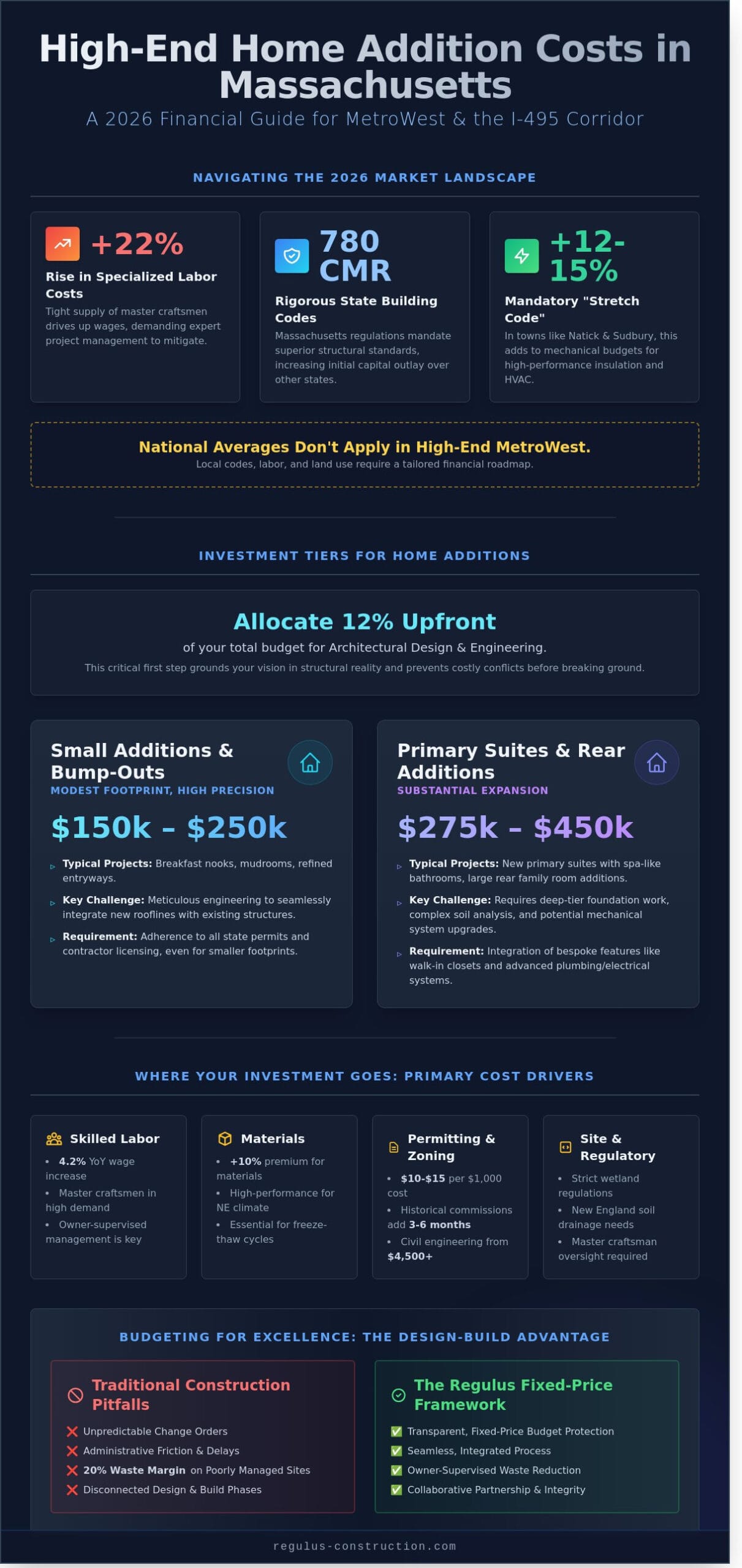
The MetroWest region enters 2026 with a unique set of economic pressures. While national trends might suggest a softening market, the I-495 corridor maintains high demand and steady appreciation. Homeowners seeking home improvement projects often find that generic online calculators fail to account for the 780 CMR Massachusetts State Building Code. These regulations mandate rigorous structural standards that ensure safety but require a higher initial capital outlay than in less regulated states.
In towns like Natick and Sudbury, the specialized Stretch Code dictates high-performance insulation and HVAC specifications. These requirements can add 12% to 15% to the mechanical budget compared to non-stretch communities. Consequently, the average home addition cost Massachusetts residents face in this luxury corridor reflects these mandatory energy efficiency benchmarks. National averages simply don’t apply when you’re building to the standards of a high-end MetroWest residence. Every bespoke project requires a tailored financial roadmap to ensure long-term value.
Local Permitting and Zoning Nuances
Permit fees in Milford, Hopkinton, and Medway are calculated based on construction value; they typically range from $10 to $15 per $1,000 of estimated cost. Historical commissions in older towns can extend architectural timelines by 3 to 6 months to ensure period-accurate aesthetics. In Norfolk and Holliston, conservation commissions strictly regulate any footprint expansion within 100 feet of wetlands. This necessitates meticulous site planning and often involves specialized civil engineering fees starting at $4,500 to ensure environmental integrity.
Labor and Material Trends in MetroWest
The availability of master craftsmen in Bellingham and Franklin remains tight in 2026. Skilled trade wages in these areas have seen a 4.2% year-over-year increase since 2024. We prioritize owner-supervised project management to mitigate these rising costs and provide a seamless experience. By maintaining direct oversight, we reduce the 20% waste margin often seen in poorly managed sites. High-performance materials designed for New England’s freeze-thaw cycles now command a 10% premium, yet they remain essential for structural longevity. Understanding the total home addition cost Massachusetts homeowners encounter requires this level of granular, local insight.
Investment Tiers: Breaking Down Home Addition Cost in Massachusetts
Determining the budget for a significant residential project requires a clear understanding of how structural complexity influences the bottom line. In 2026, the home addition cost Massachusetts homeowners encounter reflects a sophisticated blend of material quality, specialized labor, and rigorous engineering standards. A “bump-out” might expand a room’s footprint by only 48 inches, yet it necessitates the same level of architectural precision as a larger structure. Before breaking ground, allocating 12% of your total budget for architectural design and engineering ensures that the vision remains grounded in structural reality. This phase is critical for identifying potential conflicts between new designs and existing load-bearing walls.
Small Additions and Bump-Outs ($150k – $250k)
This tier typically encompasses breakfast nooks, mudrooms, or refined entryways in Milford homes. While the square footage is modest, these projects require meticulous engineering to integrate new rooflines with existing structures. Achieving a cohesive look demands more than just framing; it requires premium painting services to maintain aesthetic continuity across the exterior and interior surfaces. These smaller footprints still involve significant site preparation and must adhere to state home improvement laws regarding permits and contractor licensing. Precision at this scale prevents the “tacked-on” appearance common in lesser builds.
Primary Suites and Rear Additions ($275k – $450k)
Expanding a home’s footprint to include a primary suite or a substantial rear addition involves deep-tier foundation work. In towns like Medfield and Mansfield, soil conditions often dictate the complexity of these expansions. This investment level prioritizes the integration of spa-like bathrooms and bespoke walk-in closets. Beyond the visible finishes, homeowners should expect mechanical system upgrades. A 600-square-foot addition often exceeds the capacity of an existing furnace, requiring the installation of a dedicated HVAC zone to ensure year-round comfort. This price bracket reflects the cost of high-end fixtures and seamless structural integration.
Second-Story Additions and Whole-House Expansions ($450k+)
Vertical expansions represent the pinnacle of residential engineering. Assessing whether an existing foundation can support the weight of a second story is a non-negotiable first step that requires a structural engineer’s seal. These projects offer a turnkey experience, moving from initial architectural drawings to the final coat of paint with unwavering attention to detail. The home addition cost Massachusetts for these projects includes the temporary relocation of utilities and often a complete roof replacement. For those seeking design inspiration, our home additions MetroWest MA guide showcases how these transformations redefine luxury living. If you’re ready to explore these possibilities, consult with our team to begin your feasibility study.
Every tier of investment demands a balance of aesthetic ambition and technical integrity. Whether you are adding a single room or doubling your square footage, the success of the project rests on the expertise of your build team.
The Primary Cost Drivers: Where Your Investment Goes
Understanding the total home addition cost Massachusetts requires a transparent look at the structural and aesthetic elements that define a premium build. Site work in the MetroWest region presents unique challenges that often remain hidden until excavation begins. Our glacial soil and high water tables necessitate advanced drainage systems and reinforced footings. These foundational steps ensure the integrity of your home for decades and prevent the shifting common in older New England properties.
Structural engineering remains a non-negotiable expense for those seeking modern, open-concept layouts. We utilize high-strength steel beams and LVLs (Laminated Veneer Lumber) to replace load-bearing walls, creating the expansive vistas modern families desire. Meticulous roofline integration is equally vital to the project’s success. A master craftsman ensures the new pitch and shingle work align perfectly with the original structure so the addition doesn’t look like an afterthought, but rather a seamless extension of the original home.
Your choice of interior finishes dictates the final atmosphere and the overall budget. Bespoke cabinetry and high-performance flooring are significant investments that define the home’s character. Whether you choose custom-milled walnut or wide-plank white oak, every detail reflects our commitment to excellence and your personal vision.
Mechanical, Electrical, and Plumbing (MEP) Upgrades
Modern homes in Hopedale and surrounding towns now require robust electrical infrastructure. We frequently upgrade panels to 200-amp or 400-amp service to support 2026 appliance standards, including high-speed EV chargers and induction cooking suites. Plumbing for a second-story master bath involves complex venting and supply line routing that must be planned with precision. Integrating smart home technology during the framing phase ensures a turnkey result without visible wires. All MEP work follows Massachusetts home improvement laws and regulations to guarantee safety and strict compliance with state building codes.
Exterior Enclosure and Curb Appeal
Preserving the architectural heritage of Southborough and Mendon requires matching historic siding profiles with absolute precision. We source high-efficiency window packages designed to withstand New England’s sub-zero winters while maximizing natural light. To complete the transition to the outdoors, we often link new living spaces to composite decks MetroWest MA, creating a sophisticated flow between your interior sanctuary and the landscape. It’s a holistic approach that ensures your home addition cost Massachusetts delivers both functional value and enduring beauty.
Budgeting for Excellence: The Design-Build Advantage
Traditional “bid-build” models frequently suffer from a 20% budget escalation. This discrepancy arises because the design often exists in a vacuum, detached from the practical realities of current labor rates and material availability. Our design-build approach eliminates this friction by merging architectural creativity with construction expertise from the very first meeting. By integrating these disciplines, we provide a fixed-price residential remodeling contract that offers a level of financial transparency rarely found in the industry. This structure prevents the costly mid-construction revisions that often inflate the home addition cost Massachusetts homeowners encounter in less organized projects.
Owner-supervised management serves as the bedrock of our process. When the leadership managing your budget also oversees the daily craftsmanship, communication remains precise and actionable. We eliminate the “hidden tax” of poor communication, where vital details are lost between an independent architect and a third-party builder. Our proactive leadership ensures that every dollar is accounted for, maintaining a meticulous focus on your vision while ensuring the project remains a sound financial investment.
Managing the Design Phase Budget
A successful MetroWest project begins with a 10% to 15% allocation of the total budget specifically for professional architectural design and engineering. This isn’t a mere administrative expense; it’s an investment in precision. Selecting bespoke finishes and structural materials during this early phase allows us to lock in pricing against the 4% annual material inflation projected for 2026. Having a single point of contact throughout the project lifecycle ensures that the integrity of the design is never sacrificed for the sake of the schedule. When evaluating contractors, our guide to securing accurate home addition quotes Milford MA provides essential insights on identifying transparent pricing and avoiding the vague line items that lead to costly change orders.
Contingency Planning for 2026
Regulus Construction recommends a 10% “peace of mind” reserve for every project. In established neighborhoods like Wellesley, where many homes date back to the early 20th century, approximately 15% of renovations reveal unforeseen site conditions such as antiquated wiring or structural settling. Our fixed-price contracts provide a robust shield against market volatility. They protect your home addition cost Massachusetts investment by shifting the risk of fluctuating subcontractor rates away from your family and onto our professional management team. This disciplined approach ensures that your journey toward a transformed home is as seamless as the final result.
Ready to secure your investment with a partner who values precision as much as you do? Connect with Regulus Construction today to begin your design-build journey.
The Regulus Standard: Integrity in Every Square Foot
Regulus Construction operates on a foundation of family values and professional reliability. Unlike high-volume firms that prioritize rapid project turnover, we intentionally limit our annual engagements to ensure every detail receives our full attention. This meticulous approach is vital when managing the significant home addition cost Massachusetts homeowners face in 2026. We treat every structure as a legacy project, focusing on structural longevity rather than just immediate completion. Our promise is simple: a construction process defined by transparency and a result that reflects uncompromising quality. We believe a home addition shouldn’t feel like a temporary fix but a permanent enhancement to your family’s heritage.
Our team functions as a safe pair of hands throughout the high-stakes environment of residential construction. We understand that your home is your most valuable asset, and we approach every square foot with a master craftsman’s eye. By choosing a family-owned partner, you’re opting for a level of accountability that corporate builders simply cannot match. We don’t just build rooms; we build the backdrop for your future, ensuring that the transition between your existing home and the new addition is entirely seamless.
Bespoke Solutions for MetroWest Homeowners
Every project we undertake follows a structured timeline with 12 distinct milestones. These checkpoints keep you in control and informed at every stage, from the initial framing to the final coat of trim. Because our team has a deep professional background in high-end painting, we deliver a level of finish that many general contractors overlook. We ensure every surface is perfectly prepared and flawlessly executed. You can see the results of this precision in our portfolio of home addition ideas Milford MA, where we’ve transformed 1950s capes and modern estates into cohesive, high-end living spaces. Our work reflects 15 years of local expertise in the MetroWest region, where we’ve mastered the nuances of local architecture.
Start Your Fixed-Price Consultation
Planning a major renovation requires a steady, expert hand. Our initial assessment process isn’t a vague estimate; it’s a realistic roadmap for your investment. We provide fixed-price consultations that account for current market volatility in materials, such as the 4.2% increase in high-efficiency insulation costs recorded in late 2025. This collaborative process builds a genuine partnership between our craftsmen and your family. We act as your expert guide, handling the complexities of local zoning and technical execution so you can focus on the design vision. Contact Regulus Construction today to begin your journey toward a refined home that justifies every dollar of your home addition cost Massachusetts investment. We’re ready to provide the security and peace of mind your project deserves.
Securing Your MetroWest Legacy for 2026
Investing in your home’s future requires more than just a blueprint; it demands a clear understanding of an evolving market. Navigating the home addition cost Massachusetts residents encounter in 2026 means balancing premium materials with precise, expert execution. You’ve explored how specific investment tiers and the design-build advantage provide the structural clarity needed for a successful expansion. At Regulus Construction, we focus on specialized MetroWest luxury renovations where owner-supervised project management ensures every detail meets our meticulous standards. We remove the stress of financial ambiguity by offering fixed-price residential remodeling contracts that protect your budget from start to finish.
Our approach transforms a complex construction timeline into a seamless journey toward a bespoke living space. By prioritizing integrity and transparency, we ensure your home remains a sanctuary of quality and style for decades to come. It’s vital to have a building partner who treats your vision with the same respect as the architects who designed it. Let’s begin the process of refining your residence with the precision it deserves.
Request Your Fixed-Price Home Addition Consultation
Your path to a sophisticated, expanded home starts with a single, well-informed decision today.
Frequently Asked Questions
Is a home addition cheaper than buying a new house in Massachusetts?
Expanding your current residence is often more cost-effective than purchasing a new property when you factor in the 5% to 6% real estate commissions and high moving expenses. In the MetroWest area, avoiding the 0.456% Massachusetts transfer tax on a $1,000,000 sale saves you $4,560 alone. This approach preserves your existing mortgage rate while allowing you to tailor the space to your exact aesthetic preferences through a bespoke design process.
How much does a 20×20 addition cost in the MetroWest area?
A standard 400 square foot 20×20 addition in MetroWest typically requires an investment between $180,000 and $260,000. This home addition cost Massachusetts homeowners face varies based on the selection of luxury finishes and structural complexities. A simple family room expansion sits at the lower end of the spectrum, while a kitchen or primary suite with custom cabinetry and premium stone surfaces increases the budget by 30% or more.
Do second-story additions cost more than ground-level expansions?
Second-story additions generally cost 25% more per square foot than ground-level expansions because they require structural reinforcement of the existing foundation. Our team must often install steel beams or sister floor joists to support the new weight, which adds $15,000 to $30,000 to the initial framing phase. While ground-level builds involve excavation and concrete costs, they avoid the logistical complexity of removing and replacing an entire roof structure.
What is the average timeline for a home addition in Milford or Hopkinton?
You should plan for a timeline of 6 to 9 months from the initial design phase to the final walkthrough in Milford or Hopkinton. The permitting process in these municipalities typically takes 3 to 5 weeks; the physical construction phase spans 16 to 24 weeks depending on the project’s scale. We manage every detail of this schedule to ensure a seamless transition between the framing, mechanical, and finishing stages of your home addition cost Massachusetts investment.
Will a home addition significantly increase my property taxes in MA?
Your property taxes will increase based on the newly assessed value of your home, though the impact is manageable compared to the equity gained. For example, a $200,000 addition in Milford, where the 2024 residential tax rate is $14.12 per $1,000, results in an annual tax increase of approximately $2,824. This investment simultaneously enhances your home’s market value, often yielding a 60% to 75% return on investment upon resale.
What is the difference between a bump-out and a full addition?
A bump-out is a modest expansion that adds 2 to 10 feet of floor space to an existing room without requiring a full foundation or additional heating zone. These smaller projects are ideal for creating a breakfast nook or expanding a primary bathroom. In contrast, a full addition involves a complete structural footprint with its own foundation and roofline, providing entirely new living quarters such as a guest wing or a multi-car garage.
Does Regulus Construction offer fixed-price contracts for additions?
We provide fixed-price contracts to ensure total transparency and financial security throughout your building journey. Once the design is finalized and the meticulous selection of materials is complete, we issue a comprehensive agreement that eliminates the uncertainty of fluctuating costs. This turnkey approach allows you to focus on the creative evolution of your home while we handle the technical and budgetary management with absolute integrity.
How does the Massachusetts Stretch Code affect my addition budget?
The Massachusetts Stretch Code requires additions to meet stringent energy efficiency standards, which typically adds 5% to 8% to the initial construction budget. These regulations mandate superior insulation, high-performance windows, and airtight sealing to reduce long-term carbon footprints. While the upfront investment is higher, homeowners often see a 20% reduction in monthly heating and cooling costs, ensuring the home remains comfortable and sustainable for decades.